
Suppliers of Crocheted Decorations: Consistency in Handiwork Is the Most Valuable Asset in the Supply Chain
Nov 27, 2026
Leave a message
When sourcing crocheted decorations, a common misjudgment is to equate "handmade" with "uncontrollable." For small, low-unit-price items-such as hair clips, corsages, coasters, or hanging ornaments-variations may be negligible during the sampling phase. However, once mass production begins, issues like color discrepancies, size deviations, and inconsistent stitch tension often surface. The true professionalism of a crochet supplier lies not in their ability to execute complex patterns, but in their capacity to ensure that the 500th piece is virtually identical to the first.
Standardizing Handiwork: From "Subjective Feel" to "Defined Specifications"
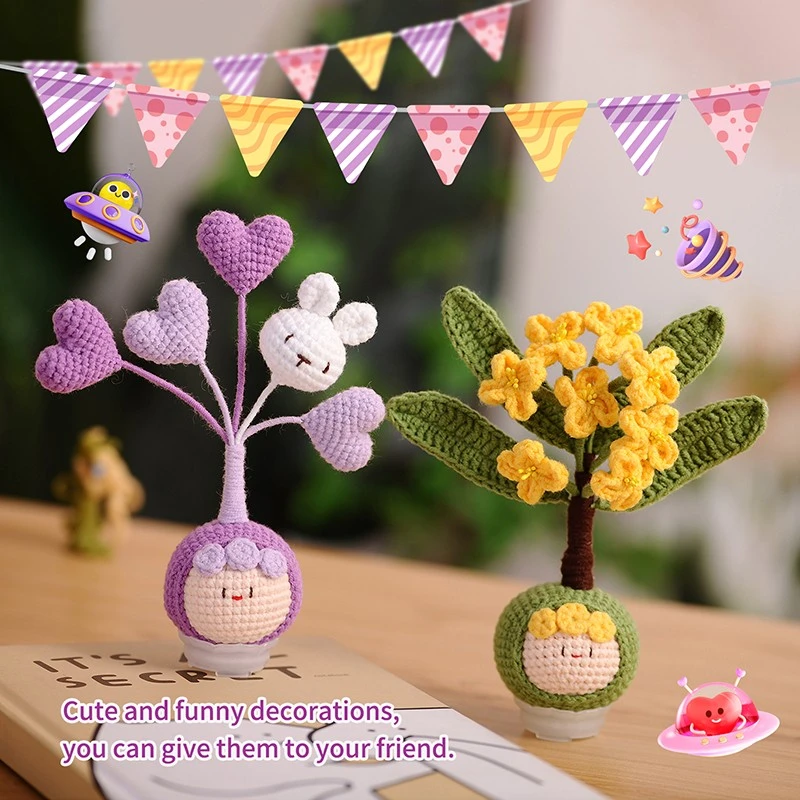
The core technique of crochet involves using a hook to form loops of yarn, interconnected to create a fabric. Basic stitches include chains, single crochets, half-double crochets, and double crochets, while more decorative variations include popcorn stitches or cluster stitches. Because the work is done by hand, natural fluctuations in tension are inevitable; yet, bulk procurement demands predictable uniformity.
In the Chaoshan region, hand-crocheting-a technique associated with the nationally recognized intangible cultural heritage "Chaozhou Drawnwork"-has evolved into a professionalized industry with a standardized language for quality control. This includes criteria for stitch density, dimensional tolerances, the finishing of yarn ends, and shaping standards. Take, for example, a simple crocheted cotton flower: while some size variation is "unavoidable" in handmade goods, a professional supplier will provide clear tolerance ranges rather than sidestepping the issue. During the sampling phase, buyers should clarify key parameters: What is the allowable size variance within a single batch? How are color differences managed between batches? Are color swatches re-verified whenever a new batch of yarn is introduced? Failing to address these questions during the sampling stage leaves no basis for accountability during mass production.

Yarn Selection: An Often-Overlooked Starting Point for Compliance
The intended end-use of a crocheted decoration dictates the specific requirements for the yarn and accessories chosen. For products used as garment accessories or items intended for contact with infants and young children, there are strict testing requirements regarding formaldehyde content, pH levels, decomposable carcinogenic aromatic amine dyes, and heavy metal concentrations. Colorfastness is equally critical; the disparity between dry and wet rubbing fastness ratings directly determines whether the product might bleed color or stain other garments due to friction or exposure to perspiration.
Professional suppliers should be able to specify the composition and origin of their yarns during the quotation phase. Cotton, acrylic, and blended yarns each have their own limitations: while cotton is skin-friendly, achieving consistent colorfastness can be challenging; acrylic offers vibrant colors but tends to have a stiffer hand-feel. A recurring principle in international B2B procurement guides is to prioritize suppliers who use high-quality acrylic or cotton, thereby avoiding issues like pilling caused by inferior yarns-a standard that applies equally to domestic procurement. For export orders, certifications such as OEKO-TEX 100 or REACH are not merely "value-adds," but essential entry requirements.
Matching Order Scale with Supplier Type
Suppliers of crocheted ornaments generally fall into two categories: manufacturers and traders. Manufacturers offer greater control over the production process and a more direct chain of accountability for lead times and quality. Traders, by contrast, provide greater flexibility in product variety and are more responsive to small-batch orders, though their quality control is contingent upon the cooperation of the factories they source from. The choice between the two depends on the specific characteristics of the order.
For customized orders involving hundreds of units or more, it is safer to work directly with a manufacturer that possesses its own production capacity. The typical minimum order quantity (MOQ) for custom crocheted items is around 500 pieces per design, though this may be negotiable down to 300 pieces for simpler designs. For off-the-shelf items or small-batch purchases intended for market testing, traders-who often offer much lower MOQs (sometimes as few as 10 units or even less)-provide a more cost-effective way to test the market. Regardless of the supplier type, requesting physical samples is an indispensable step. Beyond assessing the appearance, one must verify the uniformity of the stitch density, the security of any attached components (such as pins, cords, or beads), and ensure that the packaging matches what will be used for the final shipment.
Consistency in Repeat Orders: A Greater Challenge Than the Initial Order
In the supply chain for crocheted decorative items, it is not uncommon for an initial order to meet quality standards, only for subsequent repeat orders to fall short. This is rarely due to a decline in craftsmanship; rather, it often stems from the loss of reference standards. A change in yarn batch, a shift in the dye-bath formula, or even a change in the artisans performing the crochet work can inadvertently alter the appearance and tactile feel of the finished product.
Professional suppliers address this by retaining "sealed samples" (reference samples) and maintaining traceable specification records. Before a repeat order begins, they re-verify the currently available yarn, color references, and packaging specifications with the buyer. While this process may seem cumbersome, it effectively breaks down the vague instruction-"make it just like last time"-into concrete, verifiable material and production parameters. For buyers, requesting that the supplier retain reference samples and specification records upon the completion of the first order is the most direct way to mitigate the risks associated with repeat orders.
Procuring crocheted decorative items is, at its core, an exercise in finding an acceptable, stable range amidst the inherent variability of handmade goods. A supplier's professionalism is reflected in their willingness to clearly define the boundaries of this range, rather than using the excuse that "variations are inevitable in handmade products" to dismiss any discrepancies.